
If your espresso machine is in a U.S. home, office, or café, mineral scale can build up inside it over time. This is more common in areas with hard tap water, such as parts of Texas, Florida, Arizona, California, and the Midwest.
To descale an espresso machine, drain the water tank, add the correct descaling solution, run the solution through the machine, flush the machine with fresh water, and repeat the rinse if any smell or taste remains. Knowing how to descale espresso machine properly can help maintain performance over time. Always check your machine’s manual first, because the button sequence and approved cleaner can vary by brand and model.

What Does Descaling an Espresso Machine Mean?
Descaling removes mineral deposits from the water path inside an espresso machine. These deposits are often called limescale or scale.
Tap water contains minerals such as calcium and magnesium. When the machine heats water, some of these minerals can settle on the boiler, thermoblock, pipes, valves, and heating parts.
Scale may cause:
- Slower water flow
- Longer heat-up times
- Weak or uneven espresso
- Low steam pressure
- Noisy heating
- Water leaks
- A bitter, metallic, or chalky taste
- A machine that stops during a cleaning cycle
Descaling is different from cleaning coffee oils. A backflush cleaner removes oils from the group head and brew path. A descaler removes mineral deposits from the water system. Most espresso machines need both types of care.
Descaling also differs from sanitizing. A descaler dissolves mineral scale, but it does not replace normal washing of the water tank, drip tray, portafilter, milk system, or other removable parts.
How Often Should You Descale an Espresso Machine?
The correct schedule depends on water hardness, machine use, and whether you use filtered water. Follow the machine maker’s alert or manual when one is available.
As a general starting point:
| Water and usage pattern | Practical starting point |
|---|---|
| Soft water and light use | Every 6–12 months |
| Moderately hard water or daily home use | Every 3–6 months |
| Hard water or several drinks each day | Every 1–3 months |
| Machine displays a descale alert | Descale as soon as practical |
These are starting ranges, not universal rules. A machine used twice a week may need less frequent descaling than one used many times each day. A machine in a hard-water area may need more care even when it makes only a few drinks.
Use the machine’s water-hardness test strip, if supplied. Some machines let you program water hardness. That setting can change how often the machine asks for a descale cycle.
A water filter can reduce mineral intake, but it does not make descaling unnecessary. Filters also need to be changed on schedule. An old filter may work poorly and can itself become a source of odor or debris.

What You Need Before You Start
Prepare the following items:
- The espresso machine’s user manual
- The manufacturer-approved descaling solution
- Fresh water
- A container large enough to catch the waste liquid
- A clean cloth
- A sink for rinsing removable parts
- A timer, if the manual gives a soaking time
Before descaling, do these checks:
- Remove coffee from the portafilter and group head.
- Empty the drip tray.
- Remove the water filter if the manual tells you to do so.
- Let the machine cool if it was just used.
- Make sure the container can hold the full rinse volume.
- Keep the descaler away from children, pets, skin, and eyes.
- Do not mix descaler with bleach, soap, or another chemical.
Some machines need the water tank filled to a marked level. Others need a measured amount of solution. Use the amount stated by the manufacturer. A stronger mix is not automatically better and may damage seals or leave residue.
Which Descaling Solution Should You Use?
Use the descaler listed or approved in your machine’s manual whenever possible. Common products use acids such as lactic acid, sulfamic acid, or citric acid. Their strength and instructions are not the same.
Manufacturer descaler
This is usually the safest choice for a machine that is still under warranty. It also gives you a clear mixing and rinsing method.
Citric acid
Citric acid may be suitable for some machines, but not all. The correct amount depends on the product and the machine. Do not assume that a kitchen recipe is safe for every boiler, pump, valve, or seal.
White vinegar
Vinegar is widely suggested online, but many espresso machine makers advise against it. Vinegar can leave a strong smell, and its acid strength may not match the machine’s requirements. It may also affect seals or metal parts over repeated use.
Do not use vinegar unless your machine’s manufacturer specifically permits it.
Baking soda
Baking soda is not a proper descaler. It does not dissolve mineral scale in the way an acid-based descaler does. It can also leave residue in the water path.
Important safety rule
Never combine different cleaners. If you have already used one cleaner, flush the machine well before using another product. If the manual is unavailable, contact the manufacturer or use the exact descaler labeled for your model rather than guessing.
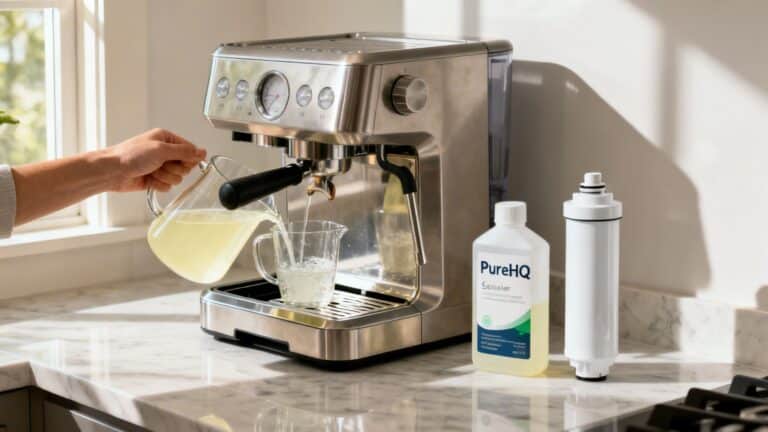
How to Descale an Espresso Machine: Step-by-Step
The steps below fit many home espresso machines, but the control sequence differs. A semi-automatic machine may use the brew switch and steam valve. A super-automatic machine may have a guided program on its display.
1. Read the machine’s descaling instructions
Look for the model number on the back, bottom, or side of the machine. Use the maker’s online manual if you no longer have the paper copy.
Check for instructions about:
- Removing the water filter
- The required solution type
- The correct water level
- Opening the hot-water or steam valve
- Using a special descale button
- How long the solution should sit
- The required rinse volume
Do not start by guessing which buttons to press. A wrong sequence may cancel the cycle or leave solution in the machine.
2. Turn off the machine and remove the water filter
Let the machine cool if needed. Remove the water tank and empty it.
If the machine uses a replaceable water filter, remove it unless the manual says to leave it in place. Descaler can shorten a filter’s useful life. Set the filter aside, or replace it if the manufacturer recommends a new one after descaling.
Wash the tank with clean water. Do not put descaler into a tank that still contains old coffee water or cleaning chemicals.
3. Mix the descaling solution
Add the approved amount of descaler and water to the tank. Use the fill line or measurement in the manual.
Do not make the solution more concentrated to speed up the job. A stronger mix can increase the risk of residue or damage without removing scale more effectively.
Place a large container under the coffee outlet, hot-water outlet, and steam wand if the machine directs liquid through each part. Use separate containers if the manual requires it.
4. Start the descale program
Turn the machine on and start its descale mode. On some machines, you must hold a button. On others, you select “Descale” from a menu.
During the cycle, the machine may:
- Pump solution in short bursts
- Pause for several minutes
- Dispense liquid from the brew outlet
- Dispense liquid from the hot-water spout
- Ask you to open or close a valve
- Ask you to empty the drip tray
Stay nearby. Do not leave a heating appliance running while you are away, especially if the container may overflow.
5. Let the machine complete the solution cycle
The solution may need time to work on mineral deposits. Do not switch off the machine during a programmed pause unless the manual tells you to do so.
If the machine stops and shows an alert, check the water tank, drip tray, container, and valve position. Avoid forcing a button sequence that is not in the manual.
Never drink the liquid collected during descaling. It contains dissolved minerals and cleaning chemicals.
6. Empty and rinse the tank
When the solution cycle ends, turn off the machine if the instructions say to do so. Empty the waste liquid.
Rinse the water tank several times with fresh water. Remove any visible film or residue. Refill the tank with clean drinking water.
Also empty the drip tray and rinse any container that held the descaling liquid.
7. Run the complete rinse cycle
Start the machine’s rinse program, or run the amount of water specified in the manual through the correct outlets.
If the machine has a steam wand or hot-water outlet, the rinse may need to pass through that part as well. The goal is to remove descaler from every section that carried the solution.
Do not stop after one short flush unless the manual says that is enough. A rinse that is too short can leave a sour taste or cleaning residue.
8. Repeat the rinse if needed
Run another tank of clean water if:
- You smell the descaler
- The water tastes sour or unusual
- The machine used a strong solution
- The manual calls for two rinses
- The water looks cloudy or contains particles
Taste the first espresso only after the machine has been fully rinsed. It is wise to discard the first shot after maintenance.
9. Reinstall or replace the water filter
Once the rinse is complete, install a new filter or reinstall the old one if the manufacturer allows it.
Reset the filter reminder if the machine has one. You may also need to reset the water-hardness setting or descale counter.
Wipe the outside of the machine and wash the drip tray, water tank, portafilter, and other removable parts.

How to Descale Different Types of Espresso Machines
The basic process is similar, but the machine design changes the details.
Semi-automatic espresso machines
Semi-automatic machines usually have a portafilter, brew group, steam wand, and separate controls.
The descaling process may require you to:
- Run solution through the brew group
- Open the hot-water valve
- Run solution through the steam wand
- Pause between outlets
- Flush the brew group and wand separately
Keep the portafilter out during descaling unless the manual says otherwise. The portafilter is not needed for most descale cycles.
Super-automatic espresso machines
Super-automatic machines often have a built-in cleaning program. The display may guide you through each step.
Follow the prompts closely. The machine may ask you to:
- Add a tablet for a separate cleaning cycle
- Remove the water filter
- Place a container under several outlets
- Empty the grounds container
- Refill the tank during the cycle
A cleaning tablet and a descaling liquid are not interchangeable. Use each product only in the cycle it was designed for.
Capsule and pod espresso machines
Capsule machines often have a smaller water path, but they still collect scale. Remove the capsule before starting.
Some pod machines have a dedicated descale button. Others use a combination of controls. Use the model manual because the process can differ even between machines from the same brand.
Machines with a boiler or heat exchanger
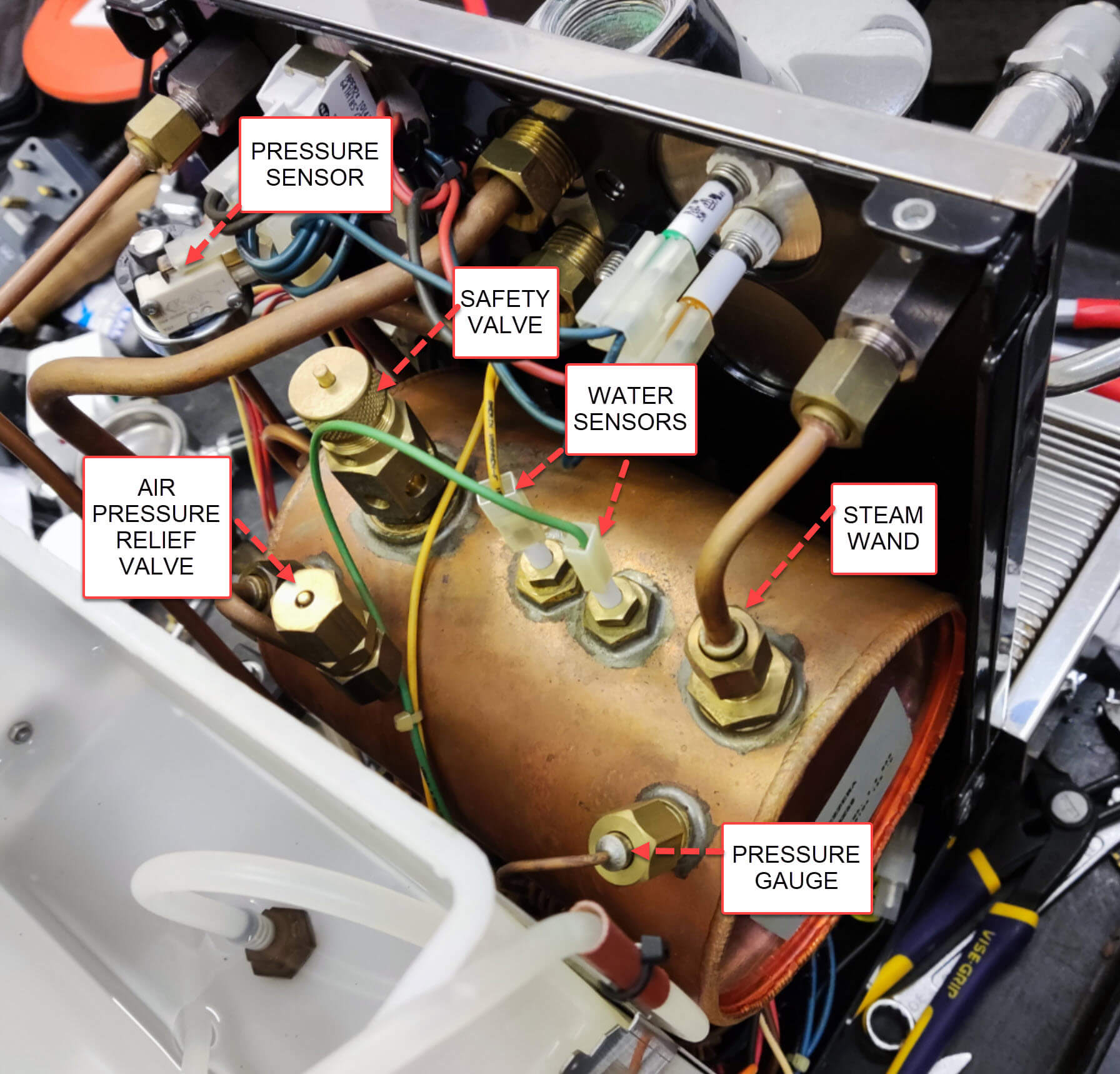
Traditional machines with a boiler, heat exchanger, or plumbed water line may need a service procedure that is more involved than a tank-based appliance cycle.
Do not open the case or remove boiler fittings unless you are trained to service the machine. Internal descaling can involve pressure, heat, electrical parts, and special tools.

What Are the Signs That Descaling Worked?
A successful descale usually produces several practical changes:
- Water flows at a normal rate
- The machine heats without unusual delay
- Steam pressure improves, if scale was limiting it
- Pump noise becomes more normal
- The machine stops showing a descale alert
- Water no longer has a chalky or sour smell
- Espresso extraction becomes more consistent
Descaling does not always fix poor espresso. A slow shot may come from a fine grind, too much coffee, a blocked basket, or old coffee oils. A machine that leaks may have a worn seal rather than a scale problem.
Run water through the machine after descaling. If the flow is still weak, clean the group screen, basket, steam tip, and removable water outlets according to the manual.
What to Do If the Machine Still Shows a Descale Alert
A descale light that stays on does not always mean the process failed. The machine may not have registered the cycle.
Try these safe checks:
- Confirm that the complete descale program finished.
- Check whether the machine needed a dedicated reset sequence.
- Refill the tank and complete the full rinse.
- Turn the machine off and on if the manual permits it.
- Check that the water filter was removed during the cycle.
- Review the manual for the correct button sequence.
- Contact the manufacturer if the alert remains.
Do not run several strong descale cycles back to back. Repeated treatment may stress seals and other parts, especially if the real problem is a blocked outlet, failed sensor, or pump fault.
Stop using the machine and seek qualified service if you notice:
- A burning smell
- Electrical sparks
- A damaged power cord
- A major leak near electrical parts
- Steam escaping from an unexpected location
- Pressure that seems unsafe
- A boiler or pump that runs continuously
How to Prevent Scale Buildup
Prevention starts with the water you use and the maintenance you follow.
Use suitable water
Use water that meets the machine maker’s requirements. Filtered water may reduce mineral buildup, but not every filter removes the same minerals.
Avoid assuming that bottled water is always better. Some bottled waters contain substantial mineral content. Distilled or very low-mineral water may also be unsuitable for machines that use conductivity sensors or require a certain mineral level.
Change filters on time
Replace the water filter at the interval stated by the manufacturer. A filter that is past its service life may not control scale well.
Empty standing water
If the machine will not be used for several days, follow the manual’s storage instructions. Emptying the tank can reduce stale water and odor, but some machines should retain water in specific internal parts.
Clean coffee residue separately
Backflush and wash the brew group as directed. Clean the steam wand after every milk drink. Mineral scale and coffee oils are different problems, so one cleaning cycle cannot replace the other.
Watch for early warnings
A change in water flow, heat-up time, pump sound, or steam power may be an early sign of scale. Acting early can be easier than trying to remove a thick deposit after months of buildup.
Common Descaling Mistakes to Avoid
Using vinegar without checking the manual
Vinegar may leave odor and may not be approved for your machine. Use the manufacturer’s cleaner unless the manual clearly allows another option.
Using too much descaler
More acid is not a better treatment. Follow the stated dose and water volume.
Leaving the filter in place
Many machines require the filter to be removed before descaling. Check the manual.
Skipping the rinse
A short rinse may leave residue inside the water path. Complete the full rinse cycle and repeat it when needed.
Descaling a hot machine
A hot surface, boiler, or steam wand can cause burns. Wait for the machine to cool as directed.
Treating every problem as scale
Scale can cause slow flow and poor heating, but it cannot explain every issue. A blocked basket, worn gasket, failed pump, or electrical fault may need a different repair.
Opening the machine
Internal parts can hold heat, pressure, or electrical energy after the machine is switched off. Leave internal repairs to a qualified technician.

Key Takeaways
- Check the machine manual before choosing a descaler or button sequence.
- Use the approved descaling product at the stated concentration.
- Remove the water filter if the manual requires it.
- Run the complete solution cycle through every required outlet.
- Rinse with fresh water until no odor or taste remains.
- Do not use vinegar, baking soda, or homemade mixtures unless the manufacturer approves them.
- Descale more often when you use hard water or make several drinks each day.
- Get service for electrical faults, serious leaks, pressure problems, or persistent alerts.
Frequently Asked Questions
Can I descale an espresso machine with lemon juice?
Do not use lemon juice unless the manufacturer approves it. Its strength is inconsistent, and it may leave pulp, sugar, or flavor residue. A descaler made for the machine gives you a more controlled treatment.
Can I use tap water after descaling?
Usually, yes, if the water meets the machine maker’s requirements. If your local tap water is hard, use a suitable filter or other approved water treatment. Check the machine manual before using distilled or very low-mineral water.
Should I descale before or after cleaning the machine?
Remove coffee residue and empty the machine before descaling. A backflush or coffee-oil cleaning cycle is separate and can be done according to the maker’s schedule. Do not mix cleaning products in the same tank or cycle.
How long does espresso machine descaling take?
Many automatic programs take about 20 to 45 minutes, including pauses and rinsing. The exact time depends on the machine, solution, water volume, and number of rinse cycles.
Why does my espresso taste sour after descaling?
There may still be descaler in the water path, or the coffee itself may be under-extracted. Run another full tank of fresh water through the machine. If the taste remains, clean the removable parts and check the coffee, grind, and extraction settings.
Can descaling fix low water pressure?
It can help when scale restricts the water path. It will not fix every pressure problem. A blocked filter basket, damaged pump, leaking valve, or faulty pressure control may require service.
Conclusion
Descaling an espresso machine is a routine maintenance task, but the correct method depends on the machine. Use the approved solution, follow the model-specific program, protect yourself from heat and chemicals, and rinse the machine fully.
For the next step, find your model number and open its official manual. Confirm the approved descaler, water volume, filter instructions, and reset procedure before starting.