
the same parts or cleaning cycle.
To clean a De’Longhi espresso machine, rinse the parts that touch coffee, clean the milk system after each use, empty the drip tray and grounds container often, and descale only when your model calls for it. If you want to know how to clean DeLonghi espresso machine parts properly, remember that the exact steps vary: a manual espresso maker and a fully automatic Magnifica do not have the same parts or cleaning cycle.
In a U.S. home, tap water can vary widely in mineral content, so one descaling schedule will not fit every kitchen. Check your model’s manual before using cleaning products or removing parts. A few minutes of regular care can help prevent stale coffee tastes, milk buildup, and blocked water flow.
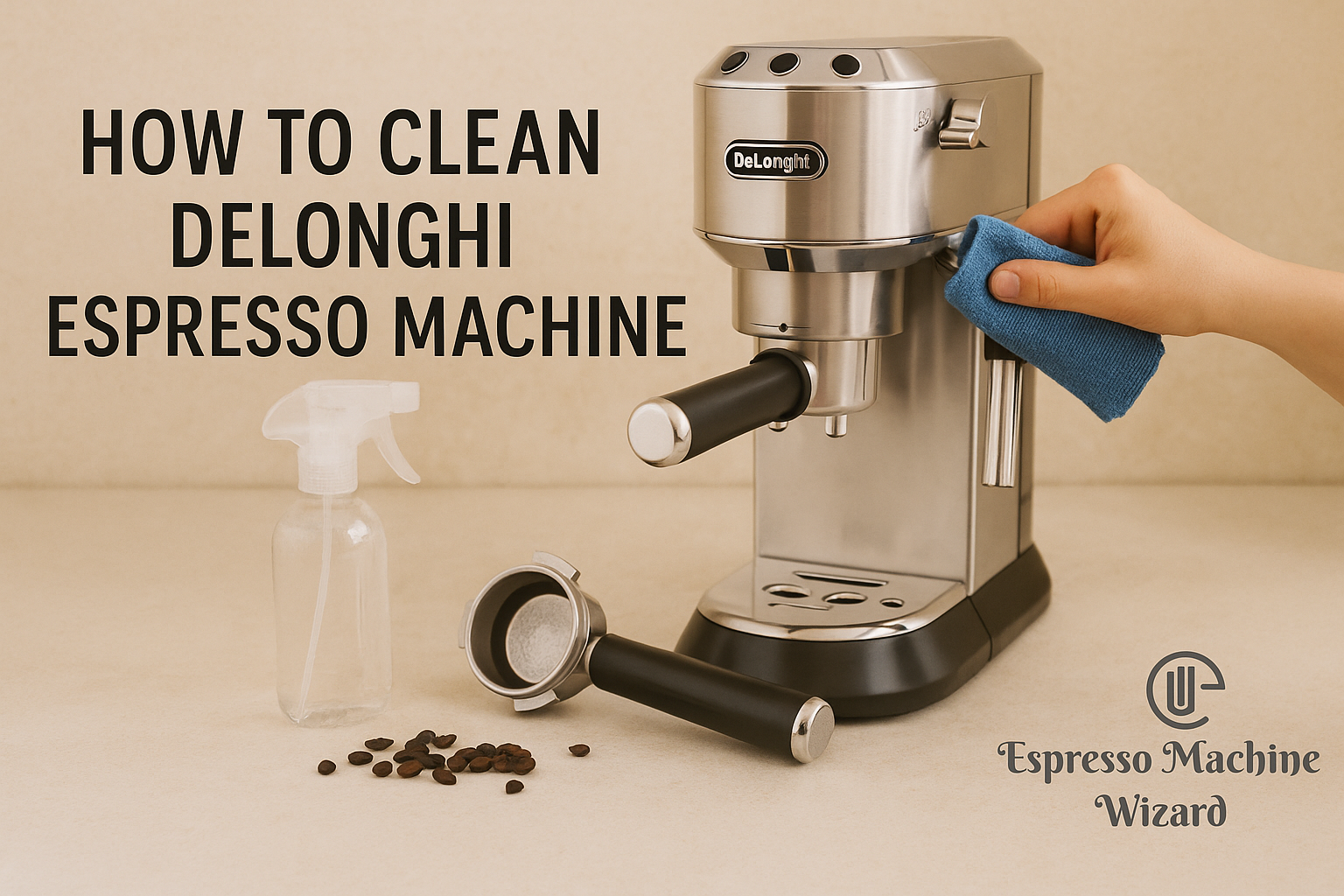
Identify your De’Longhi machine before cleaning
Find the model name or number before you start. It is often on a label on the base, back, or inside a service panel. Use that number to find the right manual on De’Longhi’s U.S. manuals page.
The main cleaning steps depend on the machine type:
| Machine type | Parts to clean often | Key caution |
|---|---|---|
| Manual espresso machine | Portafilter, basket, group head, steam wand, drip tray | Follow the manual before backflushing or using cleaning tablets. |
| Fully automatic espresso machine | Drip tray, grounds container, brew unit, coffee spouts, milk system | Remove and rinse the brew unit only as the manual directs. |
| Machine with a milk carafe | Carafe, milk tube, frother parts | Run the machine’s milk-cleaning cycle after use, if available. |
A brew unit is the part inside many automatic machines that presses coffee and moves it through the machine. Some models let you remove it for rinsing; others use a different cleaning process. Do not force a part that will not come out easily.

Clean the machine after each use
Clean fresh coffee grounds and milk residue before they dry. Dried residue can be harder to remove and may affect the next drink’s taste.
After making espresso
- Let hot parts cool. Turn the machine off and wait before handling the portafilter or other hot parts.
- Empty the coffee puck. Remove the used grounds from the basket. Rinse the basket and portafilter with warm water.
- Rinse the group head. Run a brief water-only cycle if your manual recommends it. Wipe loose grounds from the area with a soft, damp cloth.
- Wipe the outside. Use a damp cloth on the body and control area. Keep water away from electrical parts.
For an automatic machine, empty the drip tray and grounds container when the machine signals or when they are full. Rinse removable parts with warm water. Use soap or a dishwasher only if the manual says that part can handle it.
After steaming or frothing milk
Milk residue can build up quickly, so clean the milk path right after use.
- Steam wand: Wipe it with a damp cloth, then briefly release steam to clear the tip if the manual instructs you to do so. Keep hands away from the hot steam.
- Automatic milk system: Run its rinse or clean cycle after each use, following the prompts on the machine.
- Milk carafe: Take apart and rinse the parts as directed. Some parts may be dishwasher-safe, but this varies by model.
If the steam wand has a removable tip, clean it only as described in the manual. Do not poke it with a pin or other sharp object unless the instructions specifically allow it.

Do a regular deeper clean
A quick rinse handles fresh residue. A regular deeper clean removes grounds and oils that can collect in parts you do not clean after every drink.
For many De’Longhi fully automatic models, the brew unit can be removed and rinsed about once a week. Treat that as a starting point, not a rule for every machine. Check your manual for the right interval and steps.
- Turn the machine off as directed and wait for it to cool.
- Remove the brew unit only if your model’s manual says it is removable.
- Rinse it under warm water. Do not use soap or put it in the dishwasher unless the manual explicitly allows it.
- Let it air-dry if the manual calls for drying before you put it back.
- Wipe loose grounds from the compartment with a soft, dry cloth. Do not pour water into the machine body.
- Refit the brew unit and other parts as shown in the manual. Do not force them into place.
For a manual machine, clean the portafilter and basket well, and wipe coffee grounds from the group-head area. Some models support backflushing, a method that sends water back through the group head. Only backflush if your manual says your machine supports it, and use the specified basket and cleaner. Not all espresso machines are designed for this method.

Descale when your machine calls for it
Descaling removes mineral buildup inside the water system. The right timing depends on your model, water hardness, and settings. Follow the machine’s descaling light or screen prompt, and use the procedure in the manual.
In areas with harder tap water, a machine may need descaling sooner than one used with softer water. A water filter may change the schedule, too. Set the water-hardness level and filter status correctly if your machine offers those settings.
When the machine signals that it is time:
- Read the model-specific descaling instructions before starting.
- Use the descaling product and amount listed in the manual. De’Longhi recommends its EcoDecalk descaler for many machines, but check your model’s instructions.
- Follow the machine’s prompts for adding solution, running the cycle, and rinsing.
- Complete every rinse step. Do not stop the cycle early or make coffee until the machine says the process is finished.
Do not assume vinegar is a safe substitute. De’Longhi’s guidance for many models calls for a specific descaler, and vinegar may not be approved for your machine. If the manual does not clearly state what to use, check De’Longhi support before descaling.

Fix common cleaning problems safely
If a cleaning step does not work, stop before forcing a part or repeating a cycle with a stronger product. Check the display, the manual, and the machine’s setup first.
| What you notice | What to check |
|---|---|
| Coffee flows slowly or tastes off | Rinse the basket or brew unit as directed. Check for grounds around the spouts. Descale only if the machine calls for it. |
| The machine still shows a descale alert | Confirm that you completed the full rinse cycle. Check the manual for how to reset or clear the alert; some models do this automatically. |
| Milk foam is weak or the milk cycle fails | Clean the milk tube, carafe, and frother parts as directed. Check that each part is fitted correctly. |
| The brew unit will not come out or go back in | Stop and check the machine’s required power state and removal steps. Never pull or push it with force. |
| Water leaks around the drip tray | Empty and refit the tray. Check that it is seated correctly and that no removable part is out of place. |
If a warning remains after the correct cleaning cycle, or the machine leaks, makes an unusual noise, or will not complete a rinse, unplug it if safe to do so and contact De’Longhi support or a qualified repair service. Do not open the machine’s casing to reach internal electrical or hot-water parts.

Avoid these common cleaning mistakes
A few shortcuts can damage parts or leave residue behind.
- Do not submerge the machine. Clean the exterior with a damp cloth, and keep water away from the power cord and electrical areas.
- Do not use abrasive pads or sharp tools. They can scratch surfaces or damage small openings.
- Do not wash every removable part the same way. Dishwasher and soap rules vary by part and model.
- Do not pour cleaner into the machine unless the manual directs you to. Use the named cycle and solution.
- Do not skip the rinse after descaling. Cleaner left in the water path can affect taste.
- Do not force a stuck brew unit, milk connector, or tank. Recheck the model’s instructions instead.

Key takeaways
- Clean coffee-contact parts and the milk system soon after use.
- Empty and rinse the drip tray and grounds container often.
- Follow your exact model’s manual for brew-unit care, backflushing, and dishwasher use.
- Descale when prompted or at the interval set for your machine and water conditions.
- Use only an approved descaler, and complete the full rinse cycle.
Frequently asked questions
How often should I clean my De’Longhi espresso machine?
Clean milk parts after each use, and empty the drip tray and grounds container as needed. Rinse other coffee-contact parts regularly. For deeper cleaning and descaling, follow the schedule and alerts for your exact model.
Can I use vinegar to descale a De’Longhi machine?
Do not use vinegar unless your model’s manual specifically permits it. Many De’Longhi machines call for a designated descaler, such as EcoDecalk. Check the manual or contact De’Longhi support if you are unsure.
Can I put my De’Longhi brew unit in the dishwasher?
Do not put it in the dishwasher unless the manual for your model says it is safe. For many removable brew units, the guidance is to rinse with warm water and avoid soap.
Should I clean the grinder with water?
No. Keep water away from the grinder. Follow the manual’s instructions for removing loose grounds or cleaning the grinder area; use only the method and tools it allows.
What should I do if the machine still tastes bad after cleaning?
Check that the milk system, coffee spouts, basket, and brew unit are clean and fitted correctly. If the machine is due for descaling, follow its full descaling and rinse process. If the taste remains or a warning light stays on, consult the manual or De’Longhi support.
Official sources to check
Use the instructions for your exact model as the final guide. De’Longhi’s U.S. manuals page can help you find model-specific cleaning and descaling steps. De’Longhi also provides support and FAQs for questions about cleaning products and machine alerts.
Before cleaning, identify your model, then follow its manual for removable parts, cleaning cycles, and descaling. That is the safest way to keep routine care simple and avoid damage.
Pingback: How Does An Espresso Machine Work: Brewing Explained - Smart Find Today